Why Flockx Should Argue
How adversarial review and role specialization produce better creative work—and why Google's research proves it.
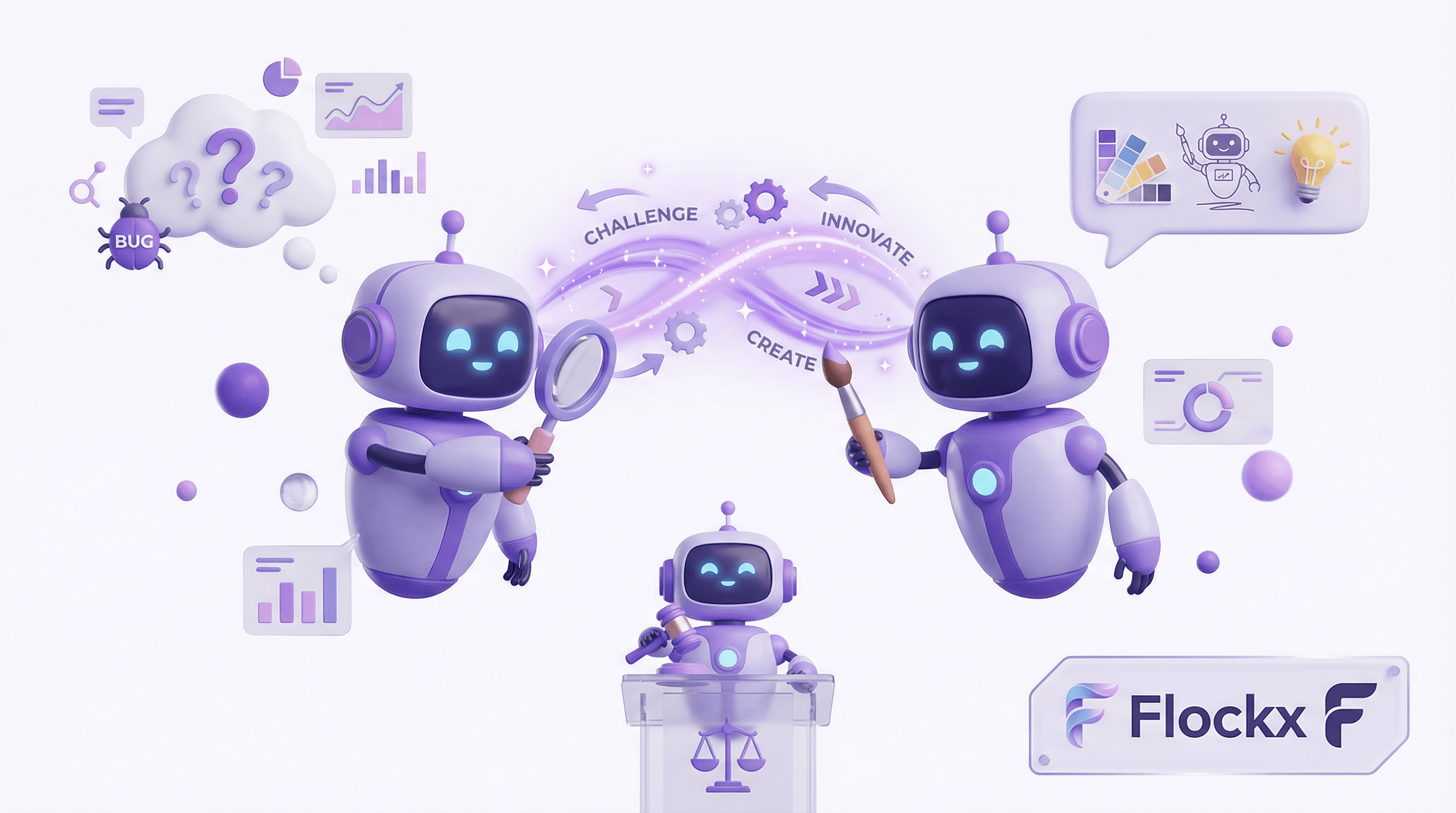
TL;DR
The best creative work comes from productive disagreement. Google DeepMind research shows that AI agents debating each other achieve 91% accuracy on complex tasks—outperforming single agents. When Flockx argues about your content, they catch what solo AI misses.
The Case for Productive Disagreement
Every creative professional knows this: your best work happens when someone challenges it. The editor who pushes back. The producer who asks uncomfortable questions. The collaborator who says "what if we tried it differently?"
Single AI assistants can't do this. They agree with you. They validate your assumptions. They're optimized to be helpful—not to challenge your thinking.
The Adversarial Advantage
Google DeepMind research shows that diverse AI models debating for 4 rounds achieved 91% accuracy—outperforming GPT-4's typical performance. When agents must defend their reasoning against challenges, errors get caught before they reach your audience.
What the Research Shows
Multi-agent debate isn't theoretical. Research from Google, Microsoft, and leading AI labs demonstrates concrete advantages:
DeepMind: Sparse Communication Topologies
Agents don't need constant communication. Sparse, focused debates achieve equal or better performance while reducing computational cost. Quality over quantity in agent interaction.
AutoRedTeamer: Adversarial Quality Control
Dual-agent systems where one agent creates and another critiques achieve 20% higher quality detection while reducing costs by 46%. The critic role is essential.
Federation of Agents: Semantic Routing
Capability-driven agent matching—routing tasks to the right specialist—achieves 13× improvement over single-model baselines. The right agent for the right job.
Value Alignment Through Debate
The Gradual Vigilance and Interval Communication framework shows multi-agent debate improves alignment with creator intent while reducing false positives.
Role Specialization: Specialists as Creative Partners
The key to productive disagreement is role clarity. Each agent in your team has a distinct perspective—and distinct responsibilities. When they review each other's work, they bring different lenses.
Clara: Content Creation
Drafts content in your voice. Optimized for creativity and flow. Needs Maya's audience lens and Sage's strategic perspective.
Maya: Marketing & Audience
Knows what resonates. Reviews Clara's drafts for audience fit, engagement potential, and platform optimization.
Sage: Strategic Planning
Ensures content aligns with long-term goals. Challenges work that doesn't serve your bigger picture.
Alex: External Relations
Reviews for relationship implications. How will this land with partners, collaborators, or your community?
When Clara drafts a blog post, Maya asks: "Will this resonate with our audience?" Sage asks: "Does this advance our quarterly goals?" Alex asks: "How might our partners perceive this?" Different questions, better outcomes.
The Adversarial Review Pattern
Here's how productive disagreement works in practice:
Creation with Intent
Adversarial Review
Strategic Challenge
Integration and Resolution
The Creator Stays in Control
Flockx's debates produce recommendations, not decisions. You see the disagreements, understand the trade-offs, and make the final call. The team amplifies your judgment—it doesn't replace it.
Distributed Context: Why Teams Know More
Every AI has a context limit—only so much information it can consider at once. Single agents must balance your voice guidelines, audience data, strategic goals, and the current task. Something gets lost.
With role specialization, each agent maintains deep context in their domain:
Together, they cover more ground than any single agent could. Each brings their specialized knowledge to bear on the work.
Consistency Through Structure
One complaint about AI-assisted content: inconsistency. Different sessions produce different styles. Brand voice drifts. Quality varies.
Adversarial review solves this. When agents review each other's work against your established standards, deviations get caught. Your voice guidelines become a "constitution" that the team enforces on itself.
Example: Voice Consistency Check
The team catches the drift. Your brand stays consistent. And you didn't have to review every word yourself.
Getting Started with Adversarial Review
You don't need to configure complex workflows. Start with the natural tension between roles:
Define Your Standards
Start with Two Agents
Make Disagreement Explicit
Review the Debates
The Bottom Line
The best creative teams argue productively. Flockx should too. When agents challenge each other's work—with clear roles and shared standards—the result is content that's been stress-tested before it reaches your audience.
Flockx isn't just a collection of assistants. It's a collaborative unit where productive disagreement produces work you can trust.
References
- Google DeepMind. (2024). Improving Multi-Agent Debate with Sparse Communication Topology. Google Research.
- Du, Y. et al. (2024). Improving Factuality and Reasoning in Language Models through Multiagent Debate. International Conference on Machine Learning.
- ArXiv. (2025). AutoRedTeamer: Autonomous Red Teaming with Lifelong Attack Integration.
- ArXiv. (2025). Gradual Vigilance and Interval Communication: Enhancing Value Alignment in Multi-Agent Debates.
- ArXiv. (2025). Federation of Agents: A Semantics-Aware Communication Fabric for Large-Scale Agentic AI.
- Harvard Business Review. (2025). Multi-Perspective AI Decision Quality in Marketing Teams.
Ready to Build a Team That Argues?
Flockx is waiting. Define the roles, set the standards, and let productive disagreement improve your work.