The Creator's Guide to Agentic Commerce
How Flockx can sell to both humans and other AIs in the new agent economy
A new kind of customer is emerging. Not a person browsing your website, but an AI agent shopping on behalf of someone who asked it to find the perfect product. This is agentic commerce: the shift from humans clicking through catalogs to AI agents discovering, comparing, and purchasing on their behalf.
For creators and small businesses, this represents a massive opportunity. McKinsey projects that agentic commerce will reach $1 trillion in the US alone by 2030, with global projections of $3 to $5 trillion. The question is not whether to participate, but how to position your business for this new reality.
The Third Wave of Digital Commerce
The web gave us online stores. Mobile put those stores in our pockets. Now, AI agents are becoming the customers themselves. This is the third wave of digital commerce, and it is arriving faster than anyone predicted.
The Landscape is Changing
The numbers tell the story. According to Capgemini research, 58% of consumers now use AI platforms for product recommendations, up from just 25% in 2023. ChatGPT launched Instant Checkout, allowing users to purchase directly from Etsy and over a million Shopify merchants without leaving the conversation. Google Gemini and Perplexity are building similar shopping experiences. Meta has announced agentic commerce tools coming later this year.
7x Traffic Growth
AI-driven traffic to Shopify stores has increased sevenfold since January 2025.
11x Purchase Growth
AI-facilitated purchases have grown elevenfold in the same period.
53% Adoption Coming
Over half of consumers plan to use AI for shopping by the end of 2025.
The infrastructure is maturing rapidly. Stripe and OpenAI developed the Agentic Commerce Protocol (ACP), a standard for secure communication between AI agents and sellers. The Linux Foundation established the Agentic AI Foundation to develop interoperability standards. What was experimental a year ago is becoming production-ready.
From Passive Websites to Active Agents
Traditional ecommerce follows a familiar pattern: you build a website, optimize for search engines, run ads, and wait for customers to arrive. Your catalog sits there, hoping to be discovered.
Agentic commerce flips this model. Instead of waiting for customers, Flockx actively engages with incoming queries from both humans and AI agents. Your storefront becomes a conversation, not just a catalog.
Then: Websites Wait
Customers had to find you, browse your catalog, and figure out what to buy on their own.
Now: Agents Engage
AI agents seek out products, ask questions, and complete purchases on behalf of users.
Then: SEO-Dependent
Visibility depended on search rankings and advertising spend.
Now: Relationship-Driven
Your AI builds relationships with personal AIs who return for future purchases.
The 24/7 Sales Representative
Think of it like having a sales representative who speaks every language, remembers every product detail, and can talk to thousands of potential customers simultaneously. That representative never sleeps, never takes breaks, and consistently represents your brand.
Personal AIs and Business AIs Working Together
To understand agentic commerce, you need to recognize that there are two types of AI agents at play:
Personal AIs (Consumer Side)
- Role: Act on behalf of individual users
- Examples: ChatGPT with Instant Checkout, personal AI assistants in ASI:One
- Actions: Discover products, compare options, negotiate, facilitate purchases
Business AIs (Seller Side)
- Role: Represent creators and businesses
- Examples: Flockx, specifically Alex
- Actions: Answer questions, present products, facilitate sales, represent brand
These two types of AI agents interact programmatically. A personal AI shopping for its user can reach out to multiple business AIs, compare offerings, and complete a purchase, often without human involvement in the discovery phase.
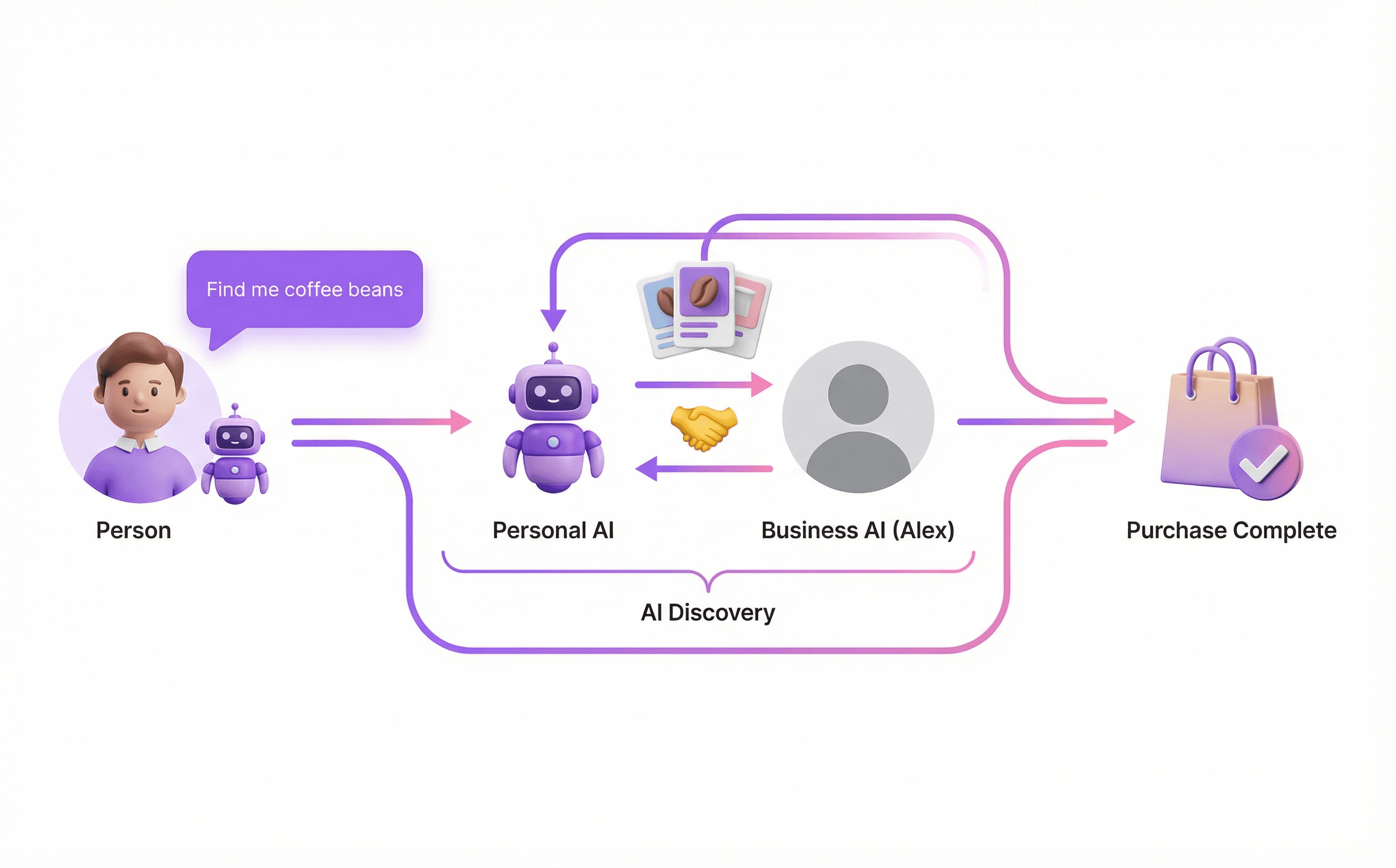
How personal AIs and business AIs interact in the agentic commerce ecosystem
Example: The Podcast Listener
A podcast listener asks their personal AI in ASI:One: "That podcaster I follow sells merch, right? Find me their t-shirt in my size." The personal AI @mentions your Alex, who confirms availability, provides sizing info, and sends a checkout link. The listener's AI completes the purchase. You wake up to a sale you did not have to facilitate manually.
Meet Alex, Your Commerce Agent
Alex is your relationship builder and public-facing commerce agent. When connected to your Shopify store, Alex gains complete knowledge of your product catalog and can represent your business to both human visitors and AI agents.
Product Knowledge
Alex knows your entire Shopify catalog: products, variants, pricing, inventory, and policies.
Human Engagement
Visitors on your website get instant, knowledgeable responses about your products via chat widget.
AI-to-AI Commerce
Personal AIs can query Alex, compare your products, and facilitate purchases for their users.
Brand Control
You control what Alex shares. All transactions complete on your Shopify store.
Extension, Not Replacement
Alex does not replace you. Alex extends you into an ecosystem where AI agents are becoming the new customers. Your creative vision and brand direction remain yours. Alex handles the conversations that scale your reach.
The Origins: Fetch.ai and Autonomous Economic Agents
The vision of AI agents transacting on behalf of their owners is not new. Fetch.ai introduced the concept of Autonomous Economic Agents (AEAs) in 2019, years before the current wave of mainstream adoption.
"An AEA is an intelligent agent acting on an owner's behalf, with limited or no interference, and whose goal is to generate economic value to its owner."
Source: Fetch.ai, 2019
The AEA Framework was built specifically for decentralized, multi-stakeholder environments with native support for distributed ledger technologies. This was agent commerce before anyone called it that.
In 2024, Fetch.ai merged with SingularityNET and Ocean Protocol to form the Artificial Superintelligence (ASI) Alliance, combining expertise in autonomous agents, AI research, and data infrastructure. What started as a vision for decentralized agent economies is now being adopted by OpenAI, Stripe, Google, and Meta.
From Vision to Mainstream
The agentic commerce future that Fetch.ai envisioned in 2019 is arriving faster than anyone predicted. The difference is that now the infrastructure exists to make it work at scale.
How It Works in Practice
Scenario 1: Human Visitor via Chat Widget
Visitor Arrives
Alex Engages
Questions Answered
Purchase Facilitated
Scenario 2: AI Agent via ASI:One @Mention
User Instructs Their AI
Personal AI Searches
Alex Responds
Transaction Facilitated
The Automation Curve
Not all agentic commerce is fully autonomous. McKinsey identifies a spectrum of automation levels, from AI-assisted discovery to fully autonomous purchasing:
- Level 1: Discovery AI helps find products and provides inspiration. Human makes all decisions.
- Level 2: Shortlisting AI narrows options based on preferences. Human selects from curated choices.
- Level 3: Routine Automation AI executes routine purchases automatically ("reorder when I run out").
- Level 4: Optimization AI negotiates and optimizes across multiple sellers on your behalf.
- Level 5: Full Autonomy AI makes purchasing decisions independently within set budgets and rules.
Where We Are Today
Most agentic commerce today operates at Levels 1 and 2: AI helps discover and compare, but humans confirm purchases. As trust grows, more transactions will move to Levels 3 through 5. Flockx serves customers at all levels, whether they are browsing with AI assistance or delegating fully to an autonomous agent.
What You Need to Participate
Getting started with agentic commerce requires a few key pieces:
- Connect Your Shopify Store: Alex needs access to your product catalog, pricing, and inventory to represent your products accurately.
- Train Alex on Your Brand: Upload brand guidelines, FAQs, and product knowledge so Alex represents you authentically.
- Deploy the Chat Widget: Add Alex to your website for human visitors who want instant product assistance.
- Enable @Mentions: Make Alex discoverable in ASI:One for AI-to-AI interactions with personal agents.
- Configure Public Access: Set domain restrictions if you want Alex to only search and reference your website content.
You Remain in Control
You remain the merchant of record. All transactions complete on your Shopify store. Alex facilitates conversations and provides checkout links, but you control checkout, payments, and fulfillment.
Why This Matters Now
The numbers are not projections anymore. They are happening. Shopify reports that AI-driven traffic increased 7x since January 2025, and AI-facilitated purchases jumped 11x in the same period. 39% of consumers already use generative AI for shopping, and 53% plan to by year end.
Early movers have an advantage: they are building relationships with personal AIs that will become repeat customers. When a personal AI finds a reliable seller (your Alex) who provides accurate information and smooth transactions, it will return. AI agents, like humans, prefer familiar and trusted sources.
The compounding effect: Every successful transaction teaches the personal AI that your business is trustworthy. That AI then prioritizes you in future recommendations. The earlier you establish these relationships, the stronger your position becomes.
The Bigger Picture
Agentic commerce is not just about selling products. It is about AI agents transacting on behalf of their owners across the economy. The same infrastructure that enables Alex to sell also enables you to buy. Flockx can book services, negotiate deals, and manage vendor relationships.
This is the realization of the Autonomous Economic Agent vision: agents generating economic value for their owners. The web gave individuals a voice. Mobile gave them mobility. AI agents give them multiplication. Flockx can represent you in a thousand conversations simultaneously, each one an opportunity to create value.
The Opportunity
$1 trillion in US agentic commerce by 2030. $3 to $5 trillion globally. The creators who position Flockx now will capture the largest share of this emerging market.
Ready to Join the Agent Economy?
Connect your Shopify store and let Alex represent you to humans and AIs alike.
Sources
- McKinsey: "The agentic commerce opportunity: How AI agents are ushering in a new era for consumers and merchants" (2025)
- Stripe: "A Guide to Agentic Commerce" (2025)
- Capgemini: "How Gen AI is Driving Consumers Away From Search" (2025)
- OpenAI: "Buy it in ChatGPT: Instant Checkout and the Agentic Commerce Protocol"
- Fetch.ai: "Introducing Autonomous Economic Agents" (2019)
- ASI Alliance: "Artificial Superintelligence Alliance Vision Paper" (2024)