Multi-Agent Collaboration for Creative Professionals
Why teams of specialized AI agents outperform solo assistants—and how this changes everything for podcasters, writers, musicians, and founders.
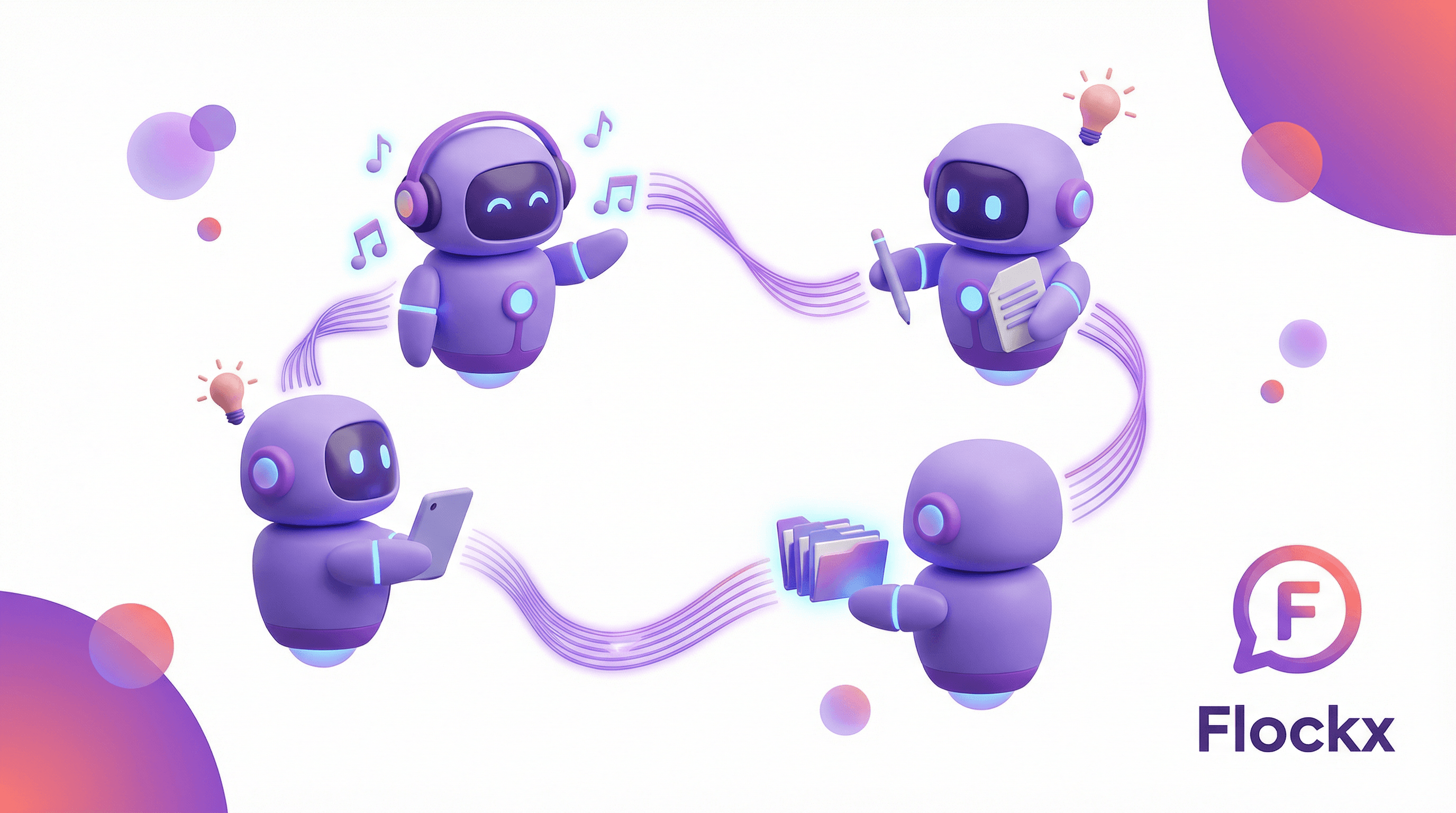
Every creative professional knows the bottleneck. It's not talent—you have that in spades. It's bandwidth. The gap between the ideas in your head and the hours in your day. You could hire a team of specialists: a researcher, an editor, a social media manager, a producer. But that takes capital, management overhead, and time you don't have.
What if you could build that team—not of humans, but of AI agents, each specialized in what they do best, collaborating on your behalf?
This isn't science fiction. Multi-agent AI systems are here, and the research is clear: teams of specialized agents dramatically outperform single, general-purpose AI assistants. For creative professionals, this shift represents a fundamental change in how we work.
The Shift from Solo AI to Team AI
You've probably experienced the limits of single-agent AI. Ask one assistant to research your topic, outline your episode, write show notes, create social clips, AND maintain your voice consistency—and quality degrades. The AI spreads itself thin. Context bleeds. Your distinct style gets lost in generic output.
The Core Insight
Microsoft's research on multi-agent systems reveals that single agents hit efficiency walls around 3-5 distinct functions. Beyond that threshold, performance drops significantly. The solution isn't a smarter single agent—it's specialized agents working together.
Think of it like hiring a team. You wouldn't expect one person to be a world-class researcher, editor, producer, and social media strategist. You'd build a team of specialists who collaborate. Multi-agent AI systems work the same way: each agent focuses on what it does best, and together they accomplish what none could alone.
Specialized Focus
Each agent masters one domain instead of juggling many.
Distributed Cognition
Complex tasks are broken down and handled in parallel.
Collaborative Coordination
Agents negotiate, refine, and build on each other's work.
Emergent Intelligence
The team produces insights no single agent could generate.
How Personal AIs and Creator AIs Collaborate
Let's make this concrete. Imagine you're a podcaster preparing an episode on the future of remote work. Here's how a team of AI agents might handle this:
Scenario: The Podcaster's Flockx
The magic isn't just parallelization—it's coordination. Unlike chatting with a single AI that forgets context between tasks, these agents communicate with each other. The Research Agent's findings inform the Outline Agent. The Voice Agent reviews what the Promotion Agent creates. They negotiate and refine, catching gaps and inconsistencies.
For writers, the pattern looks similar: an Ideation Agent generates concepts, a Drafting Agent produces prose, an Editing Agent polishes, and a Distribution Agent optimizes for different platforms. For musicians: a Composition Agent, a Lyric Agent, an Arrangement Agent, and a Marketing Agent. The principle scales across any creative domain.
The Research Behind Multi-Agent Collaboration
This isn't just intuition—it's backed by rigorous research. Recent studies in multi-agent systems reveal powerful mechanisms for AI collaboration:
Key Research Findings
- Shared Knowledge Between Agents: Agents maintain dynamic representations of what other agents know and can do. This enables fluid task handoffs and prevents redundant work.
- Smart Task Routing: Systems that track task history and agent specialization route each subtask to the optimal agent. Studies show 23.8% improvement in complex task performance compared to static assignment.
- Specialization with Coordination: Agents share a common foundation but develop specialized behaviors for their domain—maintaining coherence while maximizing expertise.
- Real-World Results: Marketing teams using multi-agent systems showed 23% better decision quality and 70% higher goal achievement rates compared to single-agent setups.
What makes this research particularly relevant for creative professionals: these systems are designed for tasks that require both specialized expertise and holistic coherence. Exactly the challenge you face when producing a podcast, writing a book, or running a creative business.
Finding the Best Experiences for Your Audience
Here's where it gets interesting: what happens when Flockx meets your audience's Personal AIs?
Example: The Musician's Reach
A musician releases a new track. Their Creator AI knows everything about the song: the mood, the influences, who it's for. When a potential fan's Personal AI seeks new music recommendations, the two AIs communicate:
Personal AI: "My human loves indie electronic with melancholic undertones. They've been listening to Bonobo and Four Tet."
Creator AI: "This new track blends ambient textures with downtempo beats, inspired by similar artists. Here's a 30-second preview tailored for first-listen hooks."
The result: the right listener finds your music through AI-to-AI collaboration that neither could achieve alone.
This AI-to-AI communication layer enables personalized discovery at scale. Your Creator AI represents your work authentically, while your audience's Personal AIs represent their genuine preferences. The handshake surfaces connections that would otherwise be lost in algorithmic noise.
For Founders
This same pattern applies to products and services. Flockx can communicate with potential customers' Personal AIs to surface relevant solutions—not through intrusive ads, but through genuine preference matching.
Getting Started with Flockx
You don't need to build Flockx overnight. Start with 2-3 core agents:
Recommended Starting Point
- An Ideation Agent: Generates concepts, topics, and creative directions based on your past work and current trends.
- A Drafting Agent: Produces first drafts in your voice, trained on your existing content.
- An Editing Agent: Refines and polishes, ensuring consistency and quality across all outputs.
As your workflow matures, expand the team: add a Research Agent for deeper insights, a Distribution Agent for multi-platform publishing, a Voice Agent for brand consistency review. Each addition multiplies your capacity without adding management overhead.
The key is teaching each agent your standards. The more you coach—correcting missteps, praising good outputs, sharing your preferences—the better they get. Over time, Flockx becomes an extension of your creative vision.
The Future of Creative Work
Single-agent AI was a breakthrough. Multi-agent AI is a transformation. For creative professionals—podcasters, writers, musicians, influencers, founders—this shift means scaling your output without sacrificing your voice.
Your bottleneck is bandwidth. Flockx is the solution.
Ready to get started with Flockx?
Scale your creative output while staying true to your voice. Start with your core agents and expand as you grow.