Structuring Specialists for Creative Flow
A framework for structuring, coaching, and optimizing multi-agent AI systems in creative workflows.
TL;DR
Single AI agents hit walls when juggling too many tasks. Multi-agent teams—where each specialist focuses on what they do best—consistently outperform solo AI. Flockx gives you a team of specialized AI agents ready to work together on your creative workflows.
!Why Single AI Agents Hit Walls
The dominant approach to AI assistance has been the single, general-purpose agent: one AI handling research, writing, editing, scheduling, and analysis. Ask it to do too much, and quality degrades.
Microsoft's research shows single agents experience performance drops when tasked with more than 3-5 distinct functional domains. Why?
Human organizations figured this out centuries ago. A publishing house doesn't ask editors to also handle printing. A recording studio separates engineering from mastering. The same principle applies to AI.
Meet Your Team
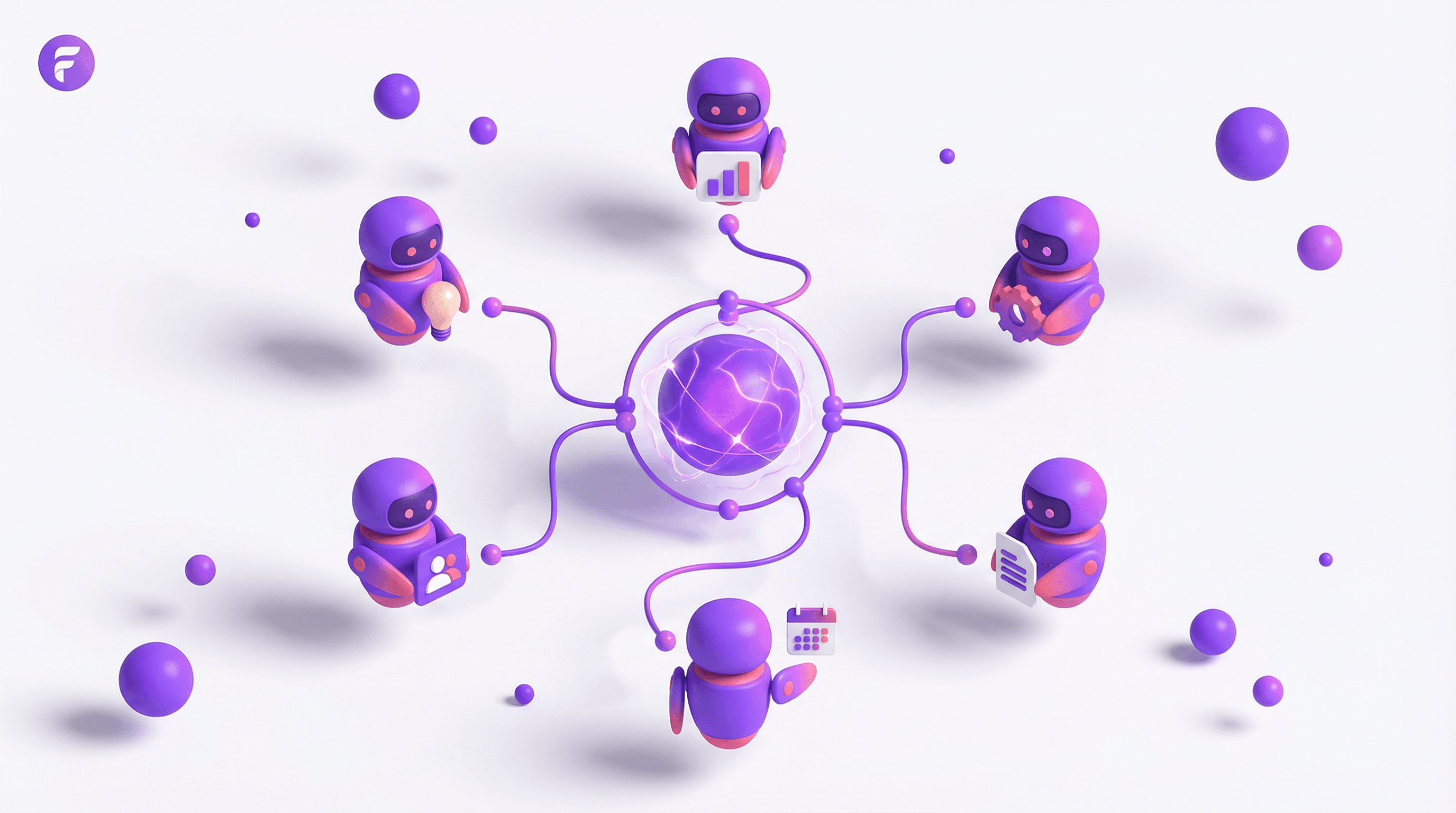
Flockx gives you a team of specialized AI agents, each focused on what they do best. Like a real creative team, they coordinate and hand off work to deliver better results than any solo agent could.
Marketing Specialist
Handles campaigns, audience targeting, and promotional strategy. Knows what resonates with your audience.
Strategic Planning Specialist
Develops roadmaps, sets priorities, and keeps your projects aligned with long-term goals.
Operations Specialist
Manages workflows, scheduling, and logistics. Keeps everything running smoothly behind the scenes.
Ambassador Specialist
Handles outreach, partnerships, and relationship building. Your voice in external communications.
Content Specialist
Creates and refines content across formats—blogs, social posts, scripts, and more.
Executive Assistant Specialist
Manages your calendar, tasks, and priorities. Keeps you focused on what matters most.
Why Specialists Outperform Generalists
By assigning clear roles, you prevent agents from becoming overwhelmed and ensure each develops genuine expertise. The result: higher quality output and faster turnaround.
How Agents Work Together
Beyond defining agent types, the framework specifies how agents should interact. Three modes govern collaboration:
Collaboration Mode
Two or more agents work closely on shared artifacts. Best when exploring new workflows or tasks requiring simultaneous expertise.
Service Mode
One agent provides a service through well-defined interfaces. Best when the interaction is predictable with clear inputs and outputs.
Facilitating Mode
An enabling agent helps another agent develop new capabilities. The goal is capability transfer, not ongoing service.
Coordination Principles
Effective multi-agent systems require careful attention to how agents coordinate:
Clear Interfaces
Each agent has well-defined inputs and outputs. Ambiguity creates confusion.
Minimal Cognitive Load
Each agent focuses on what it does best. When load increases, split agents.
Fast Feedback
Corrections propagate immediately. Agents adapt based on real outcomes.
Shared Context
Agents know what peers can do and what they're working on.
What the Research Shows
This framework builds on substantial research in multi-agent systems:
Shared Knowledge
Research on cognitive synergy shows agents that maintain dynamic representations of what their peers know enable fluid handoffs, prevent redundant work, and adapt as capabilities change.
Smart Routing
State-aware routing systems that track task history show 23.8% improvement in complex task performance. Dynamic load balancing routes work to agents with current capacity.
Specialization + Coordination
Agents can share a common foundation while developing specialized behaviors. Specializations evolve based on collaboration outcomes, not just individual performance.
Real-World Results
Field experiments with marketing teams showed 23% better decisions and 70% higher goal achievement. Multiple perspectives caught blind spots single agents missed.
Agents That Spot Automation Opportunities
Well-structured agent teams naturally identify patterns. Each agent watches the workflow segments it touches. When patterns emerge, they propose automation:
You maintain control. Proposals surface for review. Approved automations become persistent. The system learns what you want to handle personally versus delegate fully.
Getting Started
Building a high-performing Flockx setup is iterative. Here's the roadmap:
Start with 2-3 Core Agents
Define Clear Handoffs
Add Platform Agents as Needed
Introduce Enabling Agents
Track Metrics and Optimize
Measuring Success
Token Efficiency
Cost per output. Well-structured teams reduce redundant computation.
Revision Frequency
How often output needs correction. Decreasing rates = better calibration.
Output Quality
Human ratings and alignment with standards. The ultimate measure.
Coordination Overhead
Agent-to-agent communication. Too much may signal unclear interfaces.
The Bottom Line
Multi-agent systems with clear specializations outperform solo agents and uncoordinated collections. A well-structured team gives you:
The question isn't whether to adopt this approach—it's how quickly you can build and coach your team.
References
- Skelton, M. & Pais, M. (2019). Team Topologies: Organizing Business and Technology Teams for Fast Flow. IT Revolution Press.
- Microsoft Azure. (2025). Multi-agent systems design guidance. Azure Architecture Center.
- ArXiv. (2025). Orchestrated Cognitive Synergy: Multi-Agent Collaboration with Shared Knowledge Models.
- ArXiv. (2025). State-Tracking Router for Multi-Agent Collaboration.
- ArXiv. (2025). Parameter-Efficient Multi-Agent Co-Evolution.
- MIT Computer Science and Artificial Intelligence Laboratory. (2023-2024). Multi-AI collaboration studies: Reasoning and factual accuracy improvements.
- Harvard Business Review. (2025). Multi-Perspective AI Decision Quality in Marketing Teams.
Ready to get started with Flockx?
Start with core agents and expand as your needs grow.