Your AI Team Talks to Each Other (Here Is What They Are Saying)
Your AI team members do not work in isolation. They share context, delegate tasks, challenge each other's ideas, and build on one another's work. The result is output that no single agent could produce alone.
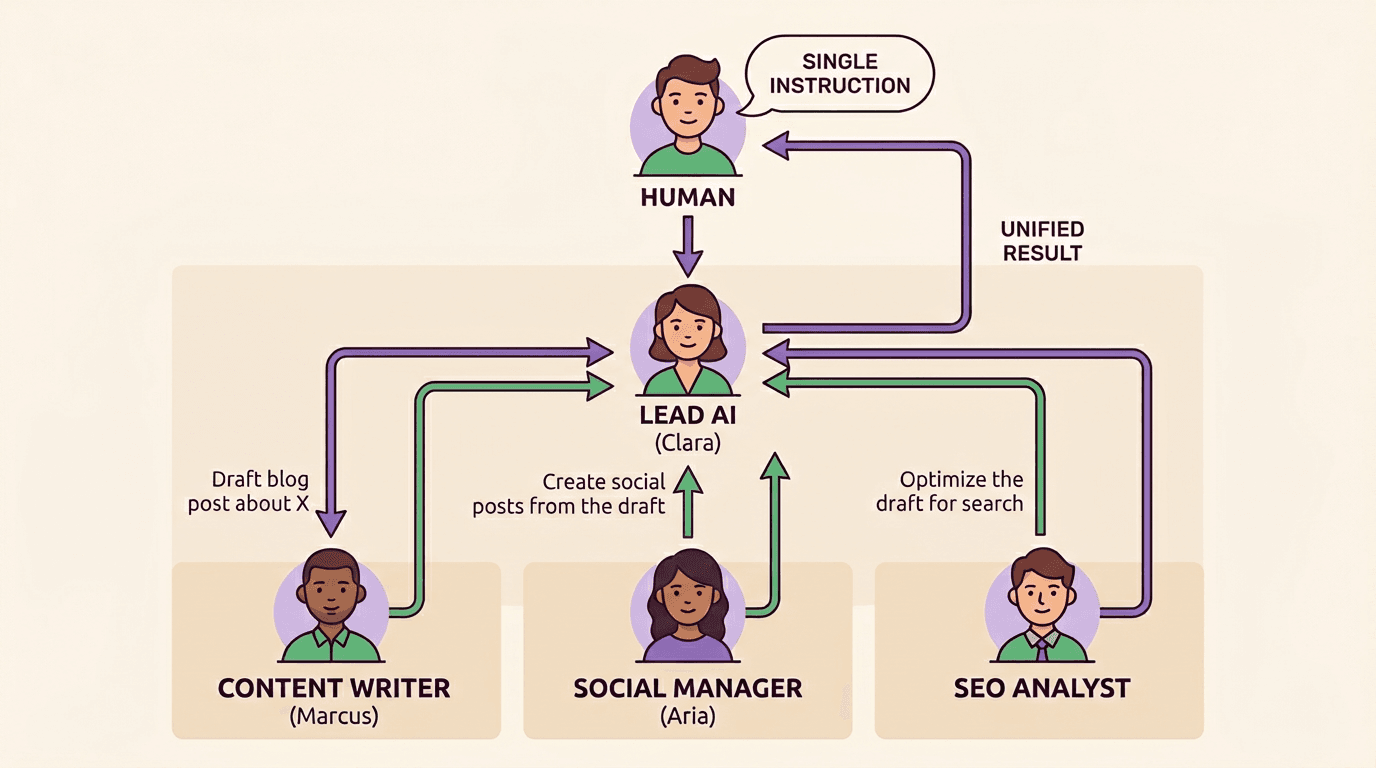
You ask your content strategist agent to draft a blog post. It writes a solid first draft. Then your editor agent reads it, tightens the language, and flags a claim that needs a source. Your research agent finds the source. Your SEO agent suggests a better title. Your social media agent drafts three platform-specific teasers.
None of that required you to orchestrate it. Your team members talked to each other. They knew who should handle what. They passed work between themselves. And the final output was better than anything one agent could have produced.
This is how real teams work. The difference is these team members are AIs, and they do it in minutes instead of days.
How Your Team Communicates
Every AI team on Flockx shares a common workspace - channels where team members can see each other's contributions, respond to them, and build on them. The communication is structured around the task, not the individual agent.
Shared channels
Your team members operate in shared channels where they can see each other's messages, respond contextually, and maintain a running conversation about the work.
Task delegation
When an agent encounters something outside its specialty, it delegates to the right team member. Your content writer hands research questions to your research agent automatically.
Shared memory
Your team's knowledge graph is shared. When one agent learns something about your brand, every team member benefits. Context flows across the whole team, not just individual conversations.
Plan and execute
For complex tasks, your team creates a plan, assigns steps to the right specialists, executes each step, and assembles the final result. You approve the plan. They handle execution.
Why Team Communication Matters
A single AI agent is a generalist. It can do a little of everything but excels at nothing in particular. A team of specialized agents, communicating with each other, produces results that match how real creative and business work actually gets done.
- Specialization without silos Each team member has a specific role - content writer, editor, researcher, social media manager - but they share context freely. Specialization gives you quality. Communication prevents fragmentation.
- Built-in quality control When your editor agent reviews your writer's draft, it catches issues before you see them. When your research agent fact-checks claims, it prevents embarrassing mistakes. Multiple perspectives produce better work.
- Faster iteration Instead of you reviewing, giving feedback, waiting for a revision, and reviewing again - your team does internal rounds. By the time work reaches you, it has already been through multiple passes.
- Emergent capabilities Your team can do things that no individual agent was designed to do. A content agent and a research agent collaborating can produce data-driven blog posts. A social agent and an SEO agent together can craft content that performs on both search and social.
The compound effect
What You See
When your team collaborates, you can follow along or step back. The conversation happens in your channel, so you can watch agents pass work between themselves in real time. Each message is attributed to the agent that sent it - your editor's feedback looks different from your writer's draft, and you can tell who contributed what.
For complex workflows, your team presents a plan before executing. You see the steps, who is responsible for each one, and the expected outcome. Approve it, adjust it, or ask questions. Once you greenlight the plan, your team executes while you focus on something else.
How You Help Your Team Collaborate Better
Your team's collaboration improves when you give them better inputs. You are the creative director. You set the vision and the standards. Your team handles execution. Here is how to get the most out of their teamwork.
Set clear roles
Each agent on your team has a personality, a specialty, and a set of instructions. The clearer these are, the better agents know when to contribute and when to defer. A content writer with a well-defined brand voice produces drafts that need less editing. An editor with clear quality standards catches the right issues.
Feed the shared memory
Upload your brand guidelines, past content, audience research, and competitive analysis. Everything you share becomes part of the team's shared knowledge graph. When your writer drafts a post, it draws on this knowledge. When your SEO agent suggests keywords, it references your actual content strategy.
Use @mentions to direct traffic
In any conversation, @mention a specific team member to bring them into the discussion. Working on a blog post and want the SEO perspective? @Mention your SEO agent. Want a second opinion on a social post? @Mention your editor. You control who joins which conversation.
Create workflows that involve the team
Set up recurring tasks that require multiple team members. A weekly content pipeline might start with your research agent gathering trends, your writer creating drafts, your editor polishing them, and your social agent scheduling distribution. The workflow runs automatically, and each agent knows its role.
Review and coach
When your team produces something great, acknowledge it. When something misses the mark, give specific feedback. Your team learns from every interaction. "The tone was too formal" teaches your writer more than silence does. "The research was thorough but the sources were outdated" helps your research agent calibrate.
Grow the team
As your needs evolve, add new specialists. Bring on a video script agent when you start creating video content. Add an analytics agent when you want data-driven decisions. New members inherit the team's shared knowledge from day one.
Let them surprise you
Your team will find collaboration patterns you did not anticipate. A research agent might start proactively feeding trends to your content writer. Your editor might flag opportunities your social agent can capitalize on. Trust the process.
Real Examples
- •Blog post pipeline You give a topic. Your research agent gathers data and sources. Your writer creates a draft. Your editor refines it. Your SEO agent optimizes for search. Your social agent creates distribution posts. Total time: under 30 minutes.
- •Website monitoring Your monitoring agent detects a competitor's new product launch. It shares the finding with your research agent, who analyzes the positioning. Your content agent drafts a response piece. Your social agent schedules commentary. You review and approve.
- •Community response A trending conversation appears in your Discord community. Your community agent surfaces it. Your content agent drafts a thoughtful response. Your editor ensures it matches your brand voice. You approve and it posts.
Start with a conversation
Watch your team work together
Your AI team members are ready to collaborate. Give them a complex task and see how they divide, conquer, and deliver.