From AI Assistant to Flockx: The Shift That Changes Everything
Why creative professionals are moving from single AI assistants to collaborative teams of specialists. And how this shift helps you scale without losing your unique voice.
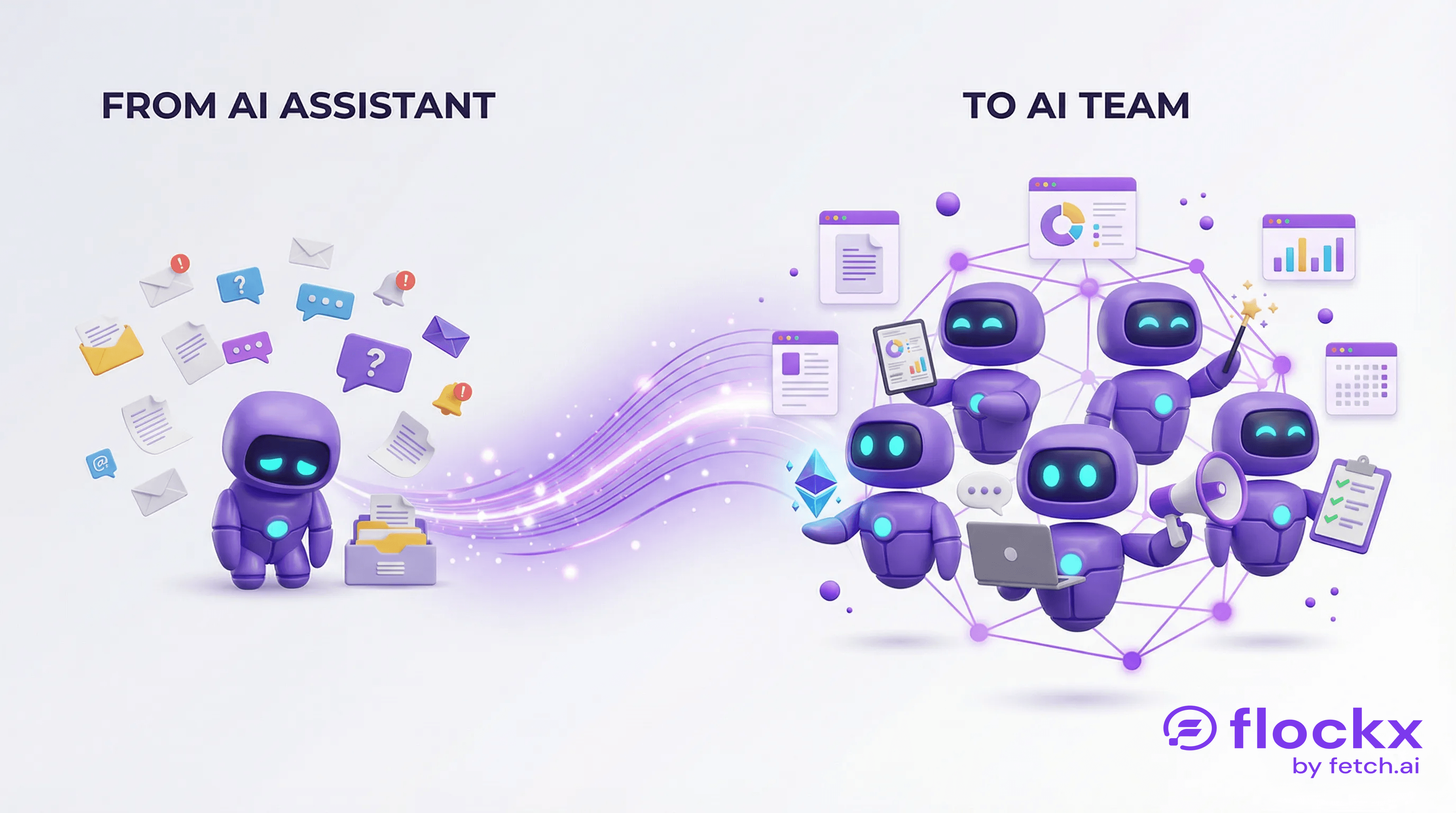
You've probably used an AI assistant. But what if you could have a content operating system? This post explores the shift from a single do-it-all AI to a collaborative team of specialists, each built to help you scale your work without losing your unique voice.
The Problem: Creative Overload
If you're a creative professional, you probably know this feeling all too well: drowning in the very success you've been working so hard to build. It's a classic bottleneck problem that shows up in different ways.
Communication Overload
Like the adventure tour operator missing bookings because they can't reply to emails fast enough. Or the café owner buried under a mountain of messages struggling to keep that personal touch.
The Content Treadmill
The nonstop, relentless pressure to create more. Think about the food blogger who loves what she does but is staring down total burnout just trying to keep up. That content treadmill never stops.
The Hidden Gold Problem
Like the podcaster with over 200 incredible episodes packed with insights. But all of it locked away in audio files, totally undiscoverable. Your best work shouldn't just vanish into the past.
The Common Thread
All these problems (communication overload, content burnout, untapped archives) point to the same thing. You've hit the limits of what one person can do, even with a single assistant. It's time for a new way to work.
The Big Idea: From Generalist to Team
The shift is simple: instead of one AI that does everything okay, you get a team where each member is a specialist. A researcher, a writer, a data analyst, a strategist. The right expert for the right job.
Research backs this up. For the complex, nuanced work that creative professionals do, specialized teams consistently outperform one-size-fits-all assistants.
Research-Backed Results
Studies on multi-agent systems have demonstrated that specialized systems outperform generalist approaches for complex creative tasks. The key is matching the right specialist to the right task. See Why Flockx Should Argue for the research behind this.
Meet the Crew
What does this look like in practice? How do different specialists work together to create stuff that's not just faster but genuinely better?

Sage / Strategic Planner
Methodical and analytical. Sage handles market research, competitive intelligence, and strategic planning so you can make informed decisions.

Otto / Operations Optimizer
Detail-oriented and process-driven. Otto optimizes workflows, tracks metrics, and automates the operational tasks that eat your time.

Maya / Marketing Specialist
Creative yet analytical. Maya plans campaigns, manages social media, and drives audience growth while keeping your brand consistent.

Clara / Content Creator
Articulate and SEO-savvy. Clara crafts blog posts, show notes, newsletters, and any content that needs to sound like you.

Alex / Relationship Builder
Outgoing and diplomatic. Alex handles networking, partnership outreach, and community engagement to build authentic connections.

Eva / Executive Assistant
Highly organized and proactive. Eva manages calendars, triages email, coordinates meetings, and keeps everything running smoothly.
Suddenly, these aren't just abstract tools. They're a real collaborative workforce working together on your behalf.
How They Work Together: Adversarial Review
The real power comes from adversarial review. Think of it like a team meeting. Clara drafts content. Maya reviews it through an audience lens: "Will this resonate?" Sage challenges whether it aligns with your strategic goals. That constructive debate between specialized viewpoints leads to stronger, more accurate work.
The Numbers Speak
Research shows that multi-agent debate can achieve up to 91% accuracy, a significant improvement over single-agent approaches. Learn more about how adversarial review improves quality.
Making Them Your Team
Having a team of experts is great, but how do you make them your team? How do you make sure they sound like you, think like you, and really understand your brand?
Train With Your Data
Feed the team your articles, your transcripts, your past work. This gives them the raw material to understand your style, your topics, and your approach.
Coach On Quality Standards
Define what "good" looks like for you. Share examples of work you're proud of and explain what makes it work. Your team learns from your standards.
Define Your Brand Voice
Articulate your unique voice so everything they create sounds unmistakably like you. The more specific you are, the better they'll match your tone.
And this isn't a one-time setup. The team learns from your feedback and new data continuously. They're building a shared memory that gets smarter about your world, your audience, and your style over time.
Real-World Results
What does this look like in practice? Here are results creative professionals are seeing:
The Email Overwhelmed Solopreneur
Was spending 3 hours a day on email. By automating the routine stuff, got back over 15 hours every single week. What could you do with an extra 15 hours?
The Drowning Consultant
A strategy consultant drowning in operational chaos deployed Flockx to handle scheduling, research, and reporting. Reclaimed 40% of her time. Shifted from busy to productive.
The Podcaster With a Buried Archive
A podcaster with 200+ episodes had valuable insights locked in audio files. Flockx made the archive searchable, boosting back-catalog plays by 156%.
The Real Shift
This isn't just about efficiency. It's about shifting your energy away from busywork and back to the creative work that only you can do. See how Alex reclaimed 40% of her time with this approach.
Preparing for the Future: Agentic Commerce
This new way of working is more than a productivity hack for today. It's about preparing for a fundamental shift in how business and commerce will work in the near future.
Agentic commerce is an emerging economy where AI agents can find opportunities, negotiate deals, and transact on your behalf. Not just with people, but with other AIs too.
Trillion-Dollar Market
McKinsey projects that by 2030, the agent-driven economy could exceed one trillion dollars.
Your Ticket to the Future
Having Flockx is not just nice to have now. It is your entry point into this emerging economy of agent-to-agent commerce.
What This Means for You
The move from a solo assistant to a content operating system is already happening. The question isn't whether this shift is coming. It's here.
How are you going to prepare for it?
- Start with one specialist: Pick the area where you need the most help (content, marketing, research) and let them learn your style.
- Provide your best work: Upload examples of content you are proud of. Your team learns from your standards.
- Give real tasks: The best way to train your team is through actual work. Start simple, then increase complexity.
- Provide feedback: When output isn't quite right, explain what to change and why. This is how your team improves.
Ready to get started with Flockx?
Stop drowning in the success you've worked so hard to build. Get a team of specialists that learns your voice and scales your output.