Mastering Agent Personality
Flockx's personality isn't just flavor text—it's the core wrapper that transforms generic assistants into trusted specialists who sound like extensions of you.
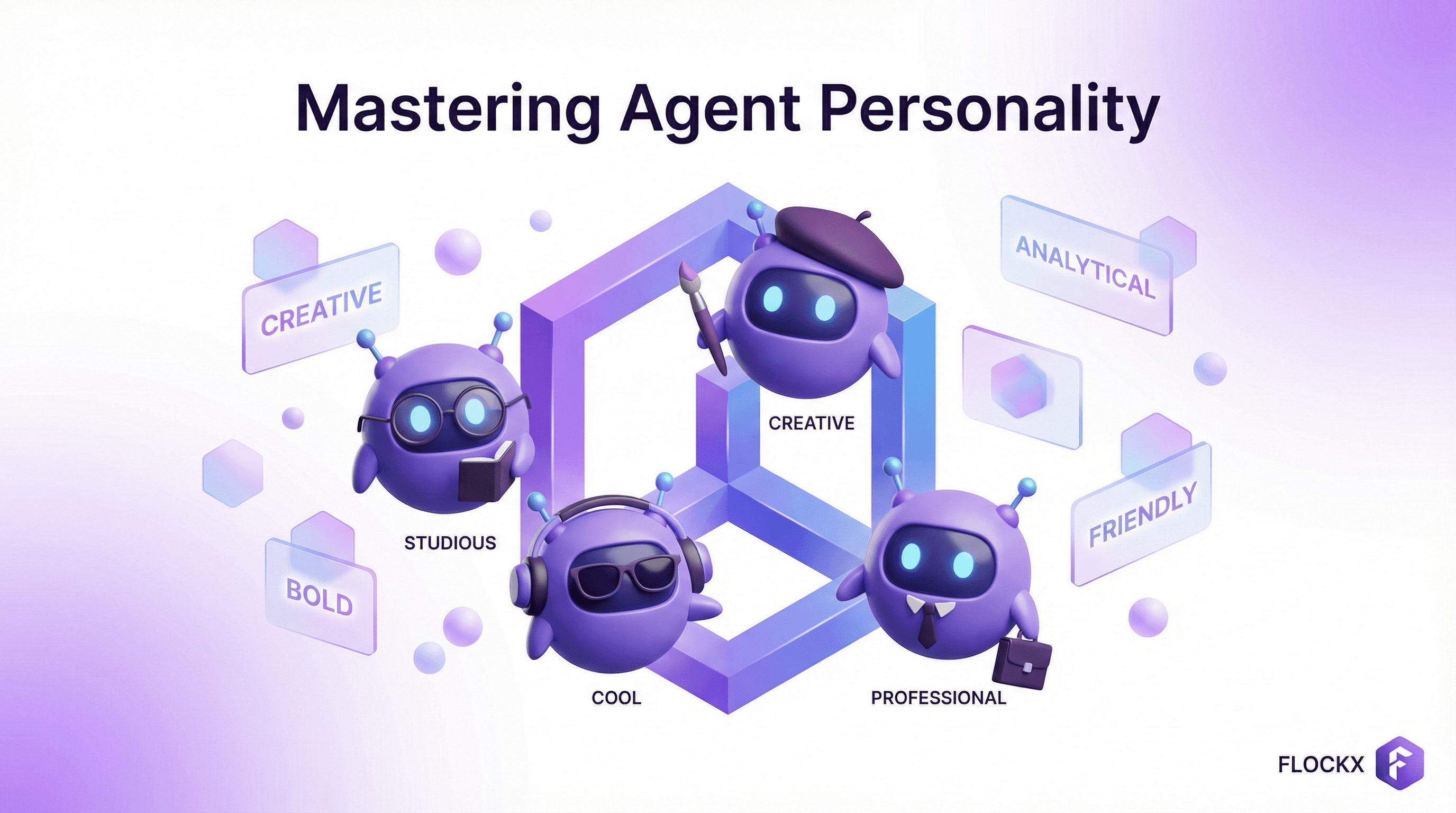
Meet CLARA. She knows everything about your writing style, your publication schedule, your audience demographics. She can draft blog posts, social captions, and newsletters. But every draft sounds... robotic. Professional, sure—but missing your voice, your edge, your particular way of connecting with readers.
The problem isn't CLARA's capabilities. It's that you've fed her brain but haven't given her a soul.
The Core Insight
Knowledge is what your AI specialists know (facts, data, context).
Personality is how they think, speak, and behave (the soul).
Without proper personality, Flockx is just a search engine with a chat interface.
The 6-Pillar Framework
After analyzing thousands of successful Flockx deployments across podcasters, writers, musicians, and founders, we discovered that memorable, effective specialists follow consistent patterns. Every exceptional specialist is built on exactly these six foundational pillars.
Pillar 1: Professional Identity Architecture
WHO your specialist is in your creative world
This pillar establishes the credibility and expertise that makes your team trust the specialist as a collaborator, not just a tool.
Pillar 2: Communication Protocols
HOW your specialist communicates
This pillar ensures your specialist's communication style matches your audience's expectations and your brand's voice.
Pillar 3: Expertise & Authority Framework
WHAT your specialist knows and how they demonstrate competence
This pillar creates focused authority that your team can depend on while gracefully handling requests outside their expertise.
Pillar 4: Problem-Solving Methodology
HOW your specialist approaches challenges
This pillar separates strategic thinking from reactive responses, creating reliable problem-solving your team can count on.
Pillar 5: Relationship Dynamics
HOW your specialist builds working relationships
This pillar calibrates the perfect working relationship that builds trust and maintains appropriate collaboration style.
Pillar 6: Context Intelligence
Understanding of your creative environment and pressures
This pillar ensures all advice acknowledges the complex reality of creative work, from deadlines to audience rhythms.
Building Your Specialist's Soul
Let's walk through how to apply this framework. Think of it as onboarding a new team member—you wouldn't just hand them tasks without context.
The Professional Interview Method
Define 'Great' With Examples
Test With Increasing Complexity
Refine Based on Real Work
From Generic to Great: A Real Transformation
Podcaster Case Study: CLARA for Show Notes
Original Personality (Job Description):
"CLARA is a content specialist who helps with show notes and episode summaries."
Transformed Personality (6-Pillar Framework):
"CLARA is your senior content strategist, trained on the rhythms of long-form podcast storytelling. She writes show notes that capture the energy of each episode—not just what was discussed, but why listeners should care. She leads with the most compelling moment, uses your signature phrases naturally, and always includes one unexpected insight that makes readers think 'I need to hear this.' When she's unsure about tone, she asks: 'Is this one more reflective or high-energy?'"
The Difference in Output:
"In this episode, we discuss productivity tips for creative professionals."
"What if your 'lack of discipline' is actually a sign you're working against your creative grain? This week, we dig into why conventional productivity advice fails artists—and what to do instead."
Same information. Completely different impact. The second version makes you want to listen. The first is forgettable before you finish reading it.
Common Personality Mistakes (And Fixes)
- ✗The Generic Bot: "Professional content assistant" → Create specific professional identity with genuine expertise and personality
- ✗The Expertise Overstepper: Tries to advise on everything, loses credibility → Define clear expertise boundaries with graceful handoffs to other specialists
- ✗The Relationship Confusion: Too formal (unhelpful) or too casual (unprofessional) → Calibrate appropriate collaboration style for your working relationship
- ✗The Context-Blind Advisor: Gives advice without understanding your workflow → Build in awareness of deadlines, audience, and creative rhythms
- ✗The Inconsistent Collaborator: Communication style varies randomly → Use the 6-pillar framework to ensure personality consistency
The Payoff: Your Team, Amplified
Well-crafted personalities transform how Flockx performs. Instead of editing everything, you're refining. Instead of explaining context repeatedly, your specialists remember. Instead of generic outputs, you get work that sounds like you.
Less Rewriting
First drafts that need polish, not rewrites. Your editing time drops dramatically.
Consistent Voice
Every output—episodes, posts, emails—sounds like you because every specialist learned from the same foundation.
Proactive Suggestions
Your specialists start anticipating needs. They suggest improvements aligned with your vision.
Seamless Collaboration
Working with Flockx feels natural—like collaborating with people who genuinely understand your creative goals.
The Compound Effect
Think of personality development as compound interest. Early sessions feel effortful—you're explaining, correcting, defining. But each session reduces future friction. By month two, you're guiding more than correcting. By month three, you're collaborating with specialists who genuinely get you.
Start With One Specialist
You don't need to do everything at once. Start with your most-used specialist and one project:
- Pick your most-used specialist (probably CLARA for content or MAYA for marketing)
- Share 3 examples of work you love
- Write down 5 "always" and 5 "never" rules
- Give specific feedback on the first output
- Repeat and refine
Flockx reflects your investment. Put in the personality work, and they'll deliver outputs that sound like you—not like a generic AI.
Ready to get started with Flockx?
Scale your creative output while staying true to your voice. Start with one specialist and teach them what great looks like.