How Flockx Works Together
Behind the scenes of multi-agent collaboration. How CLARA, MAYA, SAGE, and your other specialists coordinate to deliver better results than any single AI could.
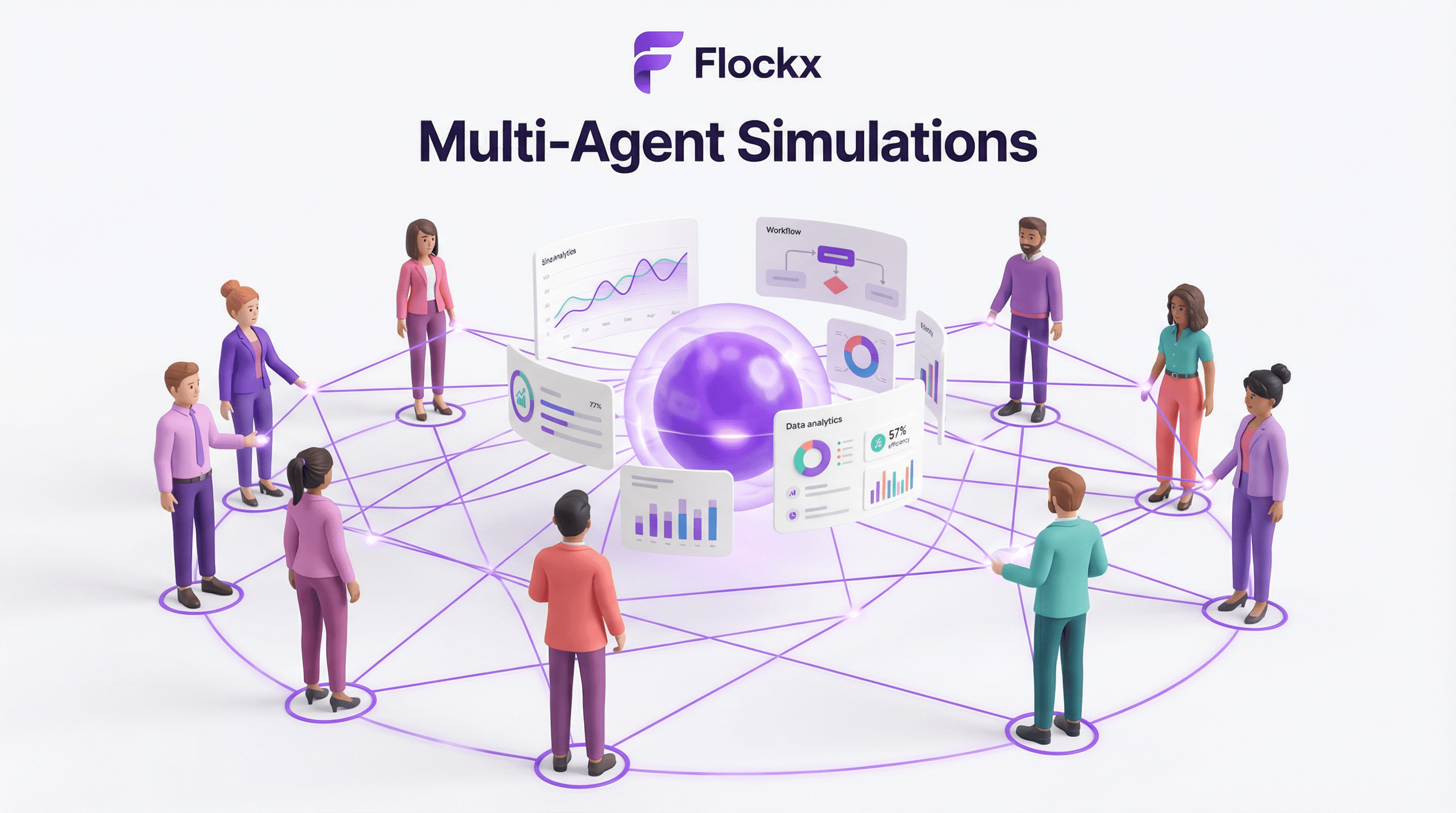
When you ask Flockx to help with a complex project, something remarkable happens behind the scenes. Multiple specialists activate, share information, and coordinate their work—producing results that no single AI could match.
This is multi-agent collaboration, and it's the foundation of what makes Flockx so powerful.
The Collaboration Principle
Just like human teams, AI specialists perform better together than alone. SAGE's research informs CLARA's writing. MAYA's marketing insights shape ALEX's community engagement. Each specialist adds their unique perspective.
Why Multiple Agents?
A single AI assistant is a generalist—good at many things, great at none. Multi-agent systems take a different approach: specialists who excel in their domain and collaborate when needed.
Deep Specialization
Each specialist focuses on their domain—content, marketing, strategy, operations. This focus enables expertise that generalists can't match.
Coordinated Intelligence
When specialists work together, they share context, build on each other's work, and catch gaps that individuals would miss.
Scalable Complexity
Complex projects that would overwhelm a single AI become manageable when divided among specialists.
Diverse Perspectives
Different specialists bring different viewpoints. SAGE asks 'Is this strategically sound?' while MAYA asks 'Will this engage the audience?'
How Collaboration Works
When you give Flockx a task, here's what happens:
Task Analysis
Your request is analyzed to understand what's needed. A blog post about a new product might need research (SAGE), writing (CLARA), and promotional content (MAYA).
Specialist Activation
The relevant specialists are brought into the conversation. Each brings their unique knowledge base, personality, and expertise to the task.
Information Sharing
Specialists share relevant context with each other. SAGE's research findings flow to CLARA. CLARA's draft informs MAYA's social posts.
Coordinated Output
The final result integrates contributions from all relevant specialists—research, writing, and marketing aligned and consistent.
A Real Example: Podcast Launch
Let's see multi-agent collaboration in action. A podcaster asks Flockx to help launch a new episode:
SAGE (Strategy)
Analyzes the episode topic, identifies key themes, researches trending angles, and suggests positioning for maximum impact.
CLARA (Content)
Takes SAGE's insights and writes compelling show notes, a blog post summary, and key quotations—all in the podcaster's voice.
MAYA (Marketing)
Creates a promotional campaign: social posts, email newsletter copy, and audiogram captions—all aligned with CLARA's messaging.
ALEX (Community)
Prepares engagement responses, FAQ answers for community questions, and discussion prompts for listener feedback.
The result: A complete launch package that would take hours to create manually, delivered in minutes with perfect consistency across all touchpoints.
The Science Behind Multi-Agent Systems
Multi-agent collaboration isn't just practical—it's grounded in research on how complex problems are best solved.
- Division of cognitive labor: Complex tasks are broken into specialized subtasks, each handled by the most capable agent.
- Emergent intelligence: The collaboration produces insights that no individual specialist would have reached alone.
- Error correction: Multiple perspectives catch mistakes and biases that single-agent systems miss.
- Contextual handoffs: Information flows between specialists with full context preserved, avoiding the "telephone game" effect.
Research Foundation
Multi-agent systems draw from decades of research in distributed computing, organizational behavior, and collaborative intelligence. The same principles that make human teams effective apply to Flockx.
Getting the Most from Your Team
Multi-agent collaboration works best when you help your specialists work together effectively.
- Train all specialists: Collaboration is only as strong as the weakest member. Make sure each specialist knows your preferences.
- Provide shared context: Brand guidelines, style guides, and core knowledge should be available to all specialists.
- Request collaboration explicitly: "CLARA, write a blog post. MAYA, create social posts to promote it."
- Review collaborative output: Check that messaging is consistent across specialists. Provide feedback when it's not.
The Future of AI Collaboration
Multi-agent collaboration is still in its early days. As Flockx becomes more sophisticated, the coordination between specialists will become even more seamless—approaching the fluid collaboration of high-performing human teams.
For creative professionals, this means an increasingly powerful platform that can handle complex projects with minimal oversight, freeing you to focus on the work that only you can do.
The Takeaway
Flockx is more than a collection of specialists—it's a collaborative intelligence that grows more capable as you work together. The more you use it, the better it gets at anticipating your needs and coordinating to deliver exceptional results.
Experience Multi-Agent Collaboration
Your team of specialists is ready to work together on your next project. See what collaborative AI can do.