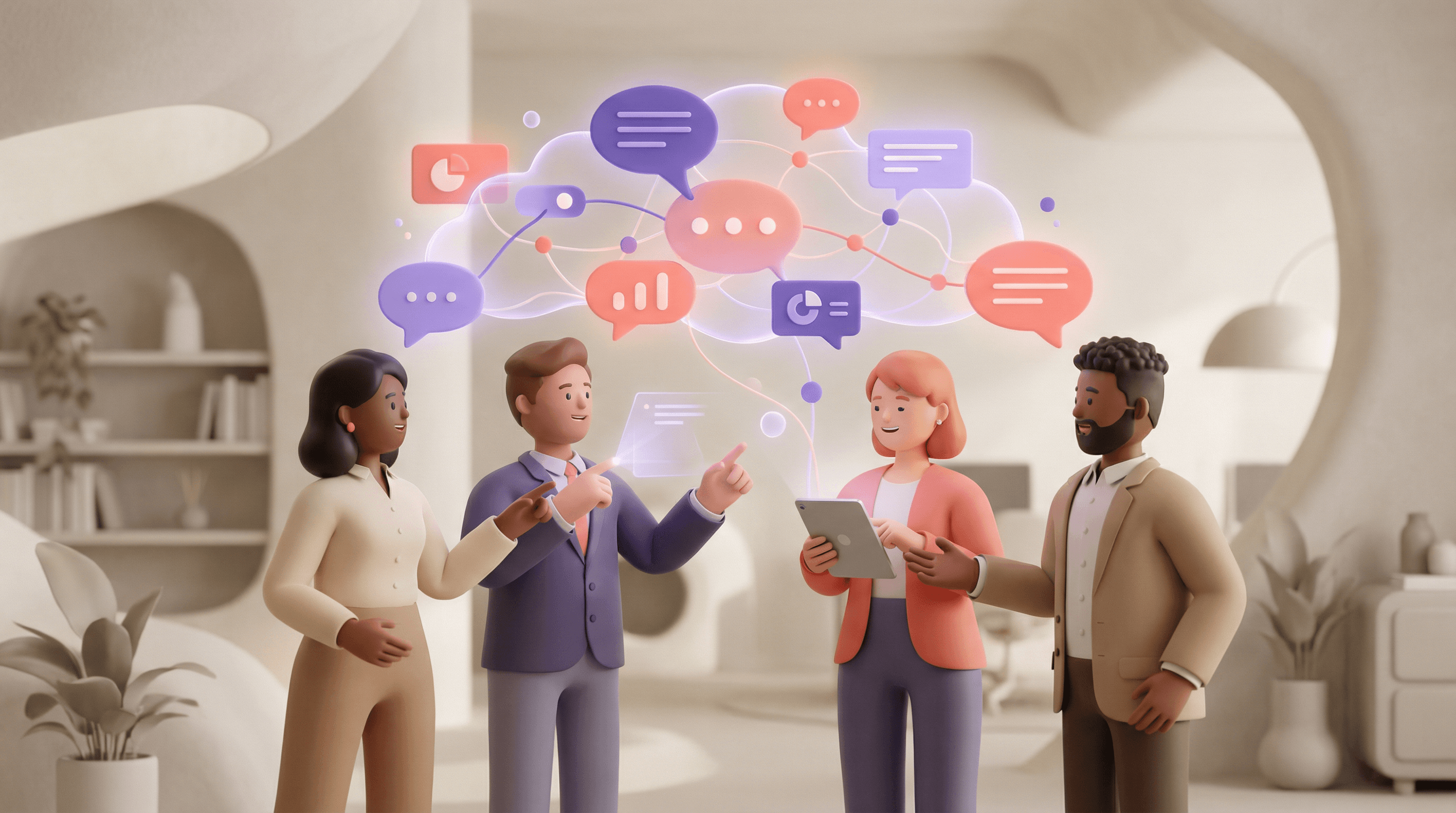
Smarter Memory, Smarter Team
Flockx now remembers who said what, learns only from trusted conversations, and builds knowledge from every participant in a shared chat. Four upgrades that make Flockx sharper with every interaction.
We wrote about how Flockx learns and remembers a few weeks ago: shared knowledge for brand alignment, individual expertise for specialized work, and the compound effect that makes your team more valuable over time.
Today we shipped four upgrades to the memory system that make all of that work better. Your team remembers more precisely, protects what it knows more carefully, and learns from a wider range of conversations.
The Short Version
Flockx can now tell people apart in its memory, learns only from conversations you trust, includes all team members in shared learning, and filters out noise so more of its memory budget goes toward real content.
Upgrade 1: Your Team Knows Who Said What
Previously, when Flockx stored memories from conversations, all human messages were attributed to a generic "User" and all AI messages to "AI." If you were chatting with Clara and mentioned your design preferences, then later asked Sage to reference that conversation, Sage would see "User said they prefer minimalist design" with no idea who "User" was.
Now every message in your team's knowledge graph is tagged with the actual person or specialist who said it. When Sage looks up a past conversation, it sees "Devon (@devon) said they prefer minimalist design" and "Clara (@clara-content) recommended a sans-serif font pairing."
Why This Matters for Creative Work
- Client attribution: When your team reviews past conversations, they know which feedback came from which client.
- Cross-specialist reference: Sage can say "Clara mentioned in Tuesday's draft review that..." instead of vague "it was discussed."
- Team accountability: Each specialist's recommendations are tracked distinctly in the knowledge graph, making it easier to see whose approach worked best.
Upgrade 2: Trust Boundaries Protect Your Knowledge
Flockx's knowledge graph is a competitive advantage. It contains your brand voice, your client preferences, your workflows, and everything that makes your team's output distinctly yours.
Before this update, every conversation your specialists participated in would contribute to their long-term memory. That included conversations with people you haven't explicitly invited to collaborate with your team.
Now your team only builds long-term knowledge from trusted conversations. If someone outside your trusted circle sends a message, your team can still respond in that conversation (using short-term, channel-scoped memory), but nothing from that exchange becomes part of their permanent knowledge base.
Think of It Like Office Access
Anyone can leave a message at the front desk (channel-scoped memory). But only trusted colleagues get access to the team's shared drive (long-term knowledge graph). The team can still have conversations with visitors, but those conversations don't reshape the team's institutional knowledge.
Upgrade 3: Every Team Member Learns from Shared Conversations
When multiple specialists participate in a conversation, all of them used to rely on a single specialist's memory of that chat. If you were talking to Clara, Otto, and Sage in a group channel, only the specialist who responded to a particular message would add it to their knowledge graph.
Now every team member who participates in a conversation builds their own memory of it. When Clara sees a message about your editorial calendar, she stores it. When Otto sees the same message, he stores it too, through his own lens of operations and workflow optimization.
The Team Meeting Analogy
Imagine a team meeting where only the person speaking takes notes. The designer hears a client request but doesn't write it down because the project manager was the one responding. Now every team member takes their own notes from every meeting. The designer remembers the visual preferences. The strategist remembers the business goals. The writer remembers the tone feedback. Same conversation, different takeaways, all valuable.
Upgrade 4: Cleaner Context, Better Recall
Flockx has a finite memory budget for each conversation, measured in tokens. Previously, internal tool calls (calendar lookups, search results, integration responses) counted against that budget. A conversation with heavy tool usage might have half its context window filled with technical plumbing instead of actual content.
Now tool messages are filtered from the memory sync pipeline. Only human messages and AI responses are stored in the knowledge graph. The result: more room for meaningful content, and a knowledge graph that's focused on ideas and decisions rather than technical artifacts.
What This Means Over Time
Week One
Your team starts tagging memories with real names. Past conversations still have generic labels, but every new interaction builds a richer, more precise knowledge graph.
Month One
Trust boundaries are established. Your team's knowledge graph reflects only trusted interactions. Cross-specialist references become more specific: "Maya noted that the client prefers warm tones" instead of "it was mentioned."
Month Three
Every specialist has a rich, multi-perspective view of your work. Conversations where Sage, Clara, and Otto all participated produce three distinct sets of takeaways. Your team's institutional knowledge is deeper and more nuanced than any single specialist could build alone.
The Compound Effect, Amplified
These four upgrades don't just add features. They multiply the value of the memory system we introduced last month. More precise attribution leads to better cross-specialist references. Trust boundaries keep the knowledge graph focused. Multi-participant learning means more perspectives. Cleaner context means higher-quality memories. Each upgrade reinforces the others.
Getting the Most Out of These Upgrades
- Use group conversations: When multiple specialists participate in a chat, all of them learn. Include the specialists who would benefit from hearing the conversation.
- Trust your collaborators: Only trusted conversations build long-term knowledge. Make sure your regular clients and collaborators are part of your trusted circle.
- Give feedback by name: "Clara, that intro paragraph was perfect" teaches Clara specifically. Named feedback is more actionable than general comments.
- Keep sharing context: These upgrades make every piece of context more valuable. Brand guidelines, client preferences, and workflow descriptions compound faster now.
Better Memory, Better Work
Memory is the foundation of expertise. A team that remembers precisely, learns selectively, and builds knowledge from every perspective produces work that keeps getting better.
These upgrades are live now. Every conversation from today forward benefits from smarter attribution, trust-aware learning, multi-participant memory, and cleaner context. Your team is already getting sharper.
Ready to Put Your Team's Memory to Work?
Flockx remembers more, learns smarter, and produces better results with every conversation. Start a group chat with your specialists and see the difference.