Stop Re-Explaining Yourself to AI
You have told it your brand voice, your audience, your preferences, and your goals. Then you open a new chat and it has forgotten everything.
The Conversation That Never Carries Forward
You have had 50 conversations with your AI tool about your podcast. Maybe 100. In at least a dozen of them, you typed something like this:
"I run a weekly podcast about entrepreneurship called The Build Phase. My audience is early-stage founders, mostly 25-40, based in the US and UK. I focus on practical advice, not inspirational fluff. My tone is direct and conversational. I have published 87 episodes..."
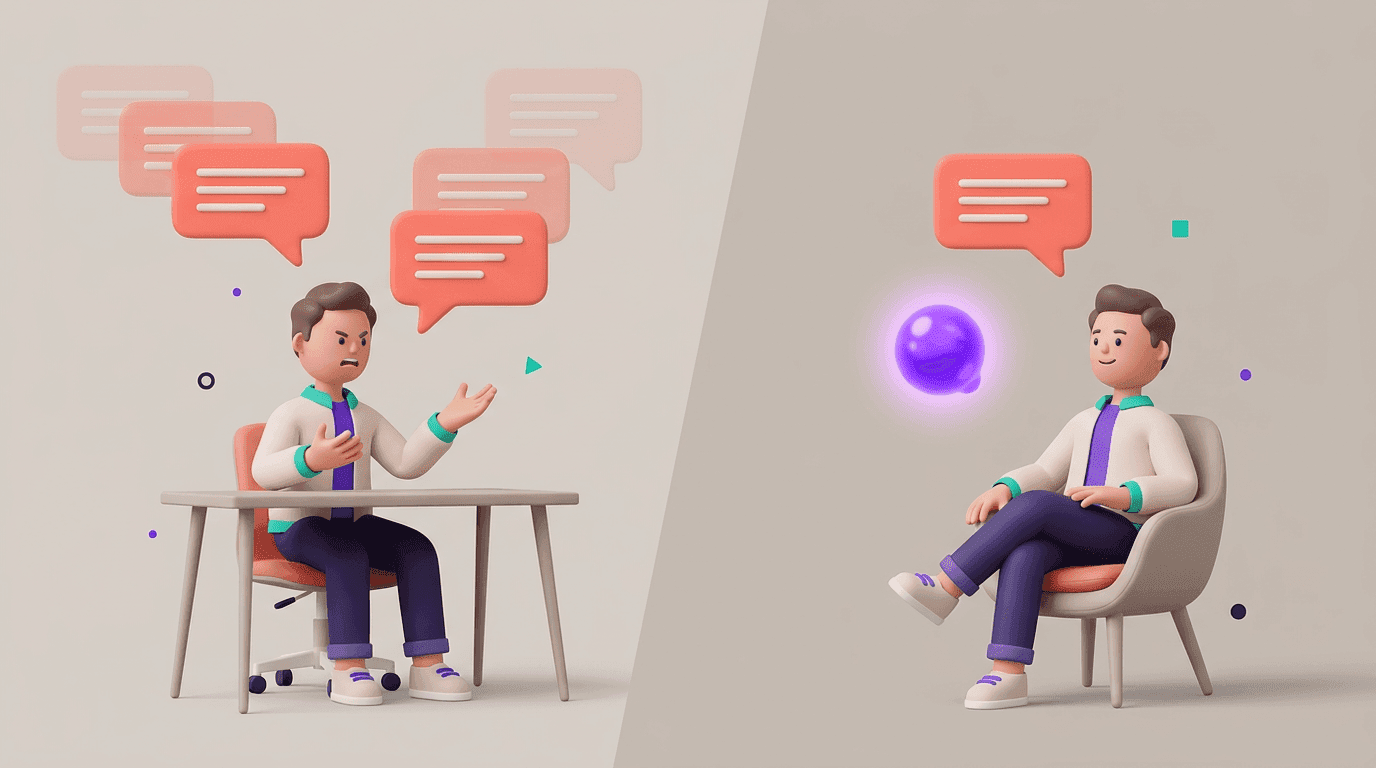
You have written that paragraph, or some version of it, more times than you can count. Each conversation starts from zero. The AI does not know you covered this topic three weeks ago. It does not know you prefer bullet points over numbered lists. It does not remember that you asked it to stop using the word "leverage" because it sounds corporate.
Every new chat is a first date with someone who has amnesia.
Why Your AI Keeps Forgetting
This is not a bug. It is a design choice. Most AI tools treat each conversation as an isolated event. When you close a chat and open a new one, the slate is wiped. The AI has no mechanism for carrying what it learned about you from one session to the next.
How Most AI Tools Handle Context
No shared memory across conversations. What you said in Monday's chat does not exist in Tuesday's.
No team context. There is one generic AI. It is not a strategist one moment and a copywriter the next. It is the same generalist trying to be everything.
No accumulated knowledge. Your corrections, your preferences, your style guide, your past output: none of it compounds. Week 10 is no smarter than week 1.
Some tools have started adding basic memory features. A line or two that persists. But there is a difference between "remembers your name" and "knows your entire brand, your audience, your content history, and the feedback you gave on last week's draft."
What Context Loss Actually Costs You
The obvious cost is time. You spend minutes at the start of every conversation re-establishing who you are, what you do, and what you need. But the less obvious costs are worse.
Time Tax
5-10 minutes per conversation re-establishing context. Across 20 conversations a week, that is 2-3 hours of repeating yourself every single week.
Inconsistent Output
The AI does not remember your last correction. So it keeps making the same mistakes. You told it to stop writing "in today's digital landscape" last week, and there it is again.
Creative Fatigue
The mental overhead of managing context manually is draining. You become an AI babysitter instead of a creator directing a team.
The deepest cost is the one you cannot measure: the work you stopped asking for. You learned that getting good output requires a long setup, so you only use AI for simple tasks where context does not matter much. The complex, high-value work where AI could actually help? You do it yourself because the re-explaining is not worth the effort.
The Hidden Pattern
Most people who say "AI does not work for my workflow" are actually saying "AI does not remember enough about my workflow to be useful." The capability is there. The continuity is not.
What Changes When Flockx Remembers
Imagine a different model. Instead of one AI that forgets, you have a team of specialists who share a persistent knowledge base. You explain your brand voice once. It persists. You correct Clara's tone on Tuesday. She remembers on Thursday. Sage's competitive research from January informs Maya's campaign strategy in February.
That is how Flockx works. Not because it has a better chatbot, but because the architecture is fundamentally different.
What Persistent Team Memory Looks Like in Practice
Your brand guide lives in the knowledge graph. Every specialist references it automatically. You do not paste it into every conversation.
Corrections stick. When you tell Clara to avoid a certain phrase, that feedback persists. She does not need to be told twice.
Knowledge compounds across specialists. Sage uploads a research report. Clara references it when writing a blog post. Maya uses both to plan a campaign. The knowledge graph connects the dots.
Week 10 is smarter than week 1. The more you work with your team, the better they get. Not because the underlying AI improved, but because the accumulated context makes every output more relevant.
The technical details of how this works (the knowledge graph, document uploads, website scans, and how context is retrieved) are covered in How Flockx Learns and Remembers. This post is about the experience, not the architecture. The experience is: you stop repeating yourself.
How Different Tools Handle Persistence
It is worth being fair about where the landscape stands. Every major AI tool has recognized that context loss is a problem. They are solving it at different levels.
| Tool | Memory Approach | Scope |
|---|---|---|
| ChatGPT Memory | Stores short facts you mention across conversations (name, preferences, role) | Conversation-level snippets. Useful for basics, limited for complex workflows. |
| Claude Projects | Attach documents and instructions to a project. All conversations in that project reference them. | Project-level context. Better than per-chat, but still one generalist AI. |
| Flockx Knowledge Graph | Persistent knowledge base shared across a team of specialists. Documents, corrections, and outputs accumulate over time. | Team-level memory. Every specialist draws from the same growing knowledge base. |
The distinction matters. Conversation-level memory means the AI remembers your name. Project-level memory means the AI can reference your documents. Team-level memory means six specialists share a growing body of knowledge about your business, your preferences, your past work, and your feedback, and every one of them gets smarter as that knowledge grows.
A Fair Comparison
ChatGPT and Claude are excellent tools for many use cases. If your work is primarily one-off conversations or quick questions, their memory features may be enough. The gap becomes obvious when your work is ongoing, multi-step, and depends on consistent context across weeks and months. That is where team-level memory changes the math.
From Repeating Yourself to Building Momentum
The moment Flockx remembers is the moment your relationship with AI shifts. You stop being a prompt engineer constantly reconstructing context. You start being a manager directing a team that already knows the playbook.
You open a chat and say: "Plan next week's content around the topic I mentioned in yesterday's strategy session." And it works. Because the strategy session is in the knowledge graph. Because Clara knows your content calendar. Because Sage already flagged that topic as trending in last week's competitive brief.
You stop managing the AI. You start managing the work.
That is what persistent context actually feels like. Not a technical feature. A fundamental change in how you work with AI every day.
The Question to Ask Yourself
How many times this week did you explain your business, your audience, or your preferences to an AI that should already know? If the answer is more than zero, the tool is not the problem. The architecture is.
Build a Team That Remembers
Your brand voice, your audience, your standards. Explain them once. Flockx carries them forward.